Reading dog body language on a group walk
Dogs talk constantly, just not in words. A little practice at listening makes every shared walk calmer, kinder and a lot more fun.
Most of us have been told that a wagging tail means a happy dog. We believed it too, until a very waggy dog on a very stiff body taught us otherwise. Tails are only one word in a long sentence.
When you walk with other owners, you will see more dogs in an hour than many of us see in a week. That is brilliant for sniffing and socialising, and it also means there is a lot of dog conversation going on. Knowing the basics helps you step in early, before a small worry becomes a big one.
We are dog owners, not behaviourists, and this is a friendly starter guide rather than a manual. Think of it as learning the first few phrases of a language.
Start with what normal looks like
The single most useful habit is knowing your own dog's usual self. How do they hold their ears when they are content? How fast do they walk? What does their mouth look like when they are just pottering?
Body language only makes sense against a baseline. A dog who always carries their tail high is telling you something different from a dog who usually has it soft and low, and suddenly doesn't. Notice the change, not just the pose.
Context matters too. A dog may look tense because there is a squirrel, a bike, or a plastic bag doing something odd. Ask yourself what has changed in the last few seconds.
Signs of a comfortable dog
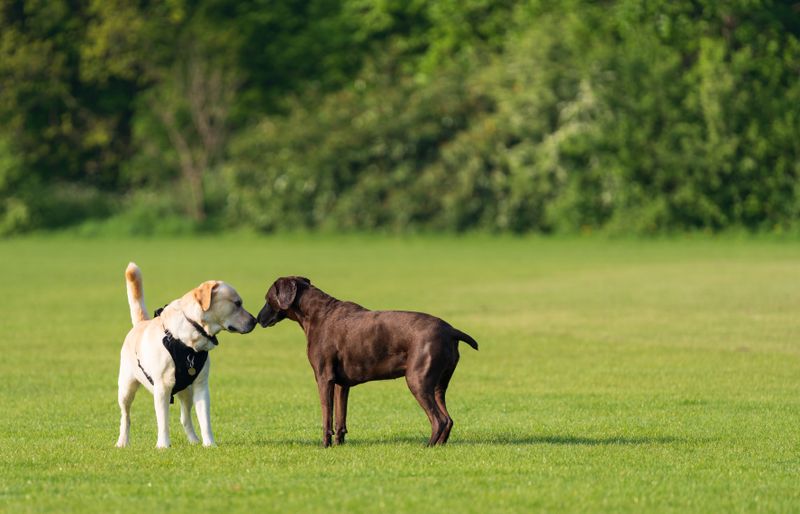
Relaxed dogs tend to look loose and a bit wobbly. Their movements are fluid, their faces soft, and they can easily turn away from something interesting to sniff the ground or check in with you.
- A soft, loose body that moves in curves rather than straight lines.
- Ears and eyes that look relaxed, with a gentle face and a mouth that may be slightly open.
- Easy sniffing, shaking off and pausing to look around.
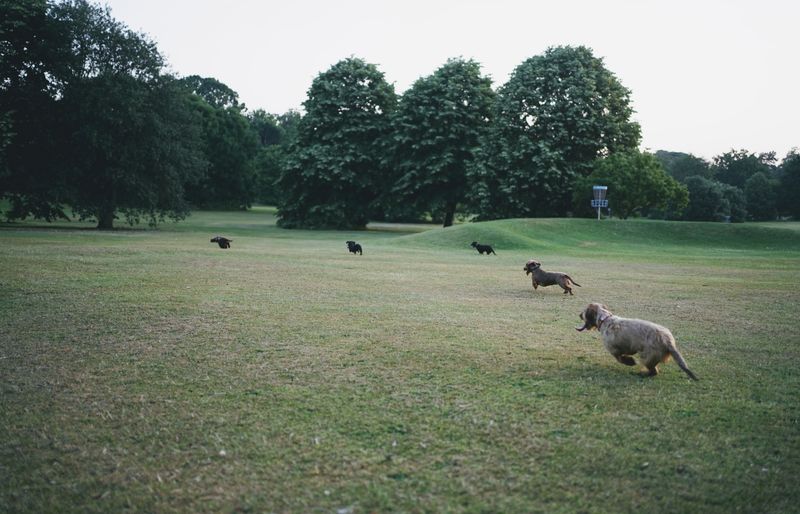
- Play that takes turns: chasing then being chased, with little pauses and role swaps.
- A dog who can walk away from the fun and come back when they choose.
That last one is a good test. Healthy play is a two-way street, and both dogs should be able to take a break without trouble.
Signs a dog is unsure or wants space
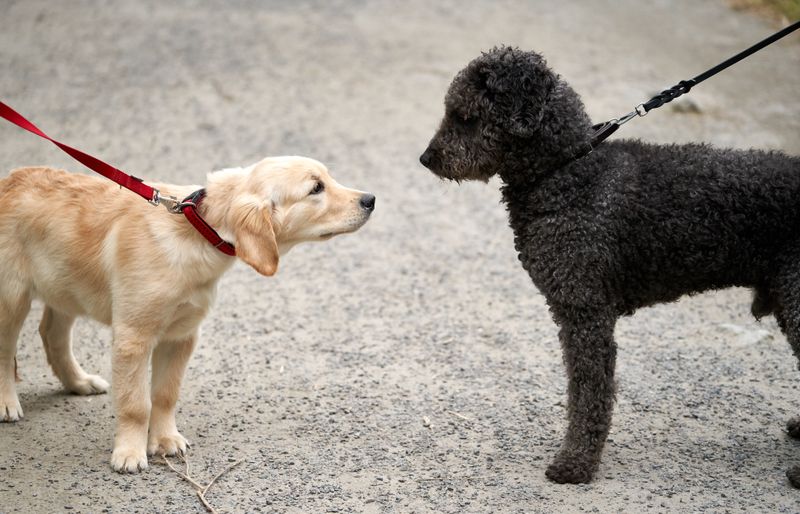
Dogs usually whisper before they shout. Many of the signs below are polite requests for distance. If we notice and respond to them, dogs rarely need to say it more loudly.
No single sign proves anything. Look for a cluster of them, and trust the picture rather than one detail.
- Freezing or going very still, particularly with a closed mouth and a hard stare.
- Turning the head or body away, or trying to walk behind you.
- Lip-licking, yawning or a sudden shake-off when nothing is making them wet or sleepy.
- A tucked or very stiff tail, a lowered body, or weight shifted backwards.
- Showing the whites of the eyes, or flattened ears.
- Sniffing the ground suddenly and intensely, as a way of avoiding a direct stare.
- Pulling hard towards or away from another dog, or going very quiet when they are normally chatty.
When play is getting too much
Rough-and-tumble can look alarming and still be fine, and calm-looking moments can hide trouble. The key is to look for balance and breaks.
Signs that play may be tipping over include one dog constantly pinned or chased, a dog repeatedly trying to escape and being followed, a dog hiding behind their person, or noise and tension climbing rather than settling. Big young dogs and small older ones sometimes need a gentle pause even when everybody means well.
A quick interrupt that keeps things friendly
If you spot too much, a calm, upbeat call to your own dog, a few steps away from the group and a treat for coming to you is usually plenty. You are not telling anyone off, just changing the subject. Keep it cheerful.
What to do when you see the signs
Stop and look
Take a breath and check the whole dog and the whole situation. What changed? Who is closest? Is there a way out for each dog?
Add distance
Walk calmly in a gentle arc away from the other dog. Distance is the kindest reset there is, and it costs nothing.
Reward the calm
When your dog looks to you or settles, tell them they are brilliant and offer a treat if they take food. This builds trust.
Tell the other owner
A quick "he is feeling a bit much, so we will walk ahead for a bit" keeps everyone on the same page, and most owners are relieved to hear it.
Decide together what next
You might carry on at a distance, swap places in the group or call it a day. All of those are good outcomes.
Why we built this into Packmates
We built Packmates because we have all felt the awkwardness of a walk that doesn't suit one of our dogs. That is why every dog has a profile, with size, energy, lead behaviour and comfort around other dogs, and why walks carry tags like Calm welcome or Slow pace.
Those are tools for choosing well in the first place. Reading body language is how you keep a good walk good once you are out there. Each one supports the other.
- Walk types that suit nervous dogs
- Needs space, Senior / slow, or a walk tagged Calm welcome
- Who has the final say
- The organiser, though you can always step back for your own dog
- When things feel off
- Add distance, tell the organiser, and head home if you need to
Remember that organisers are fellow owners, not professionals or trainers. You know your dog best, so it's always fine to say "we're going to step away".
When to ask for professional help
A dog who is frequently frightened, snaps or growls, or seems different from usual may be in pain or struggling with something that needs expert help. Please start with a check-up from your vet to rule out health problems.
If behaviour is the worry, look for an accredited behaviourist, for example through the Association of Pet Behaviour Counsellors or the Animal Behaviour and Training Council. The Dogs Trust also has helpful general advice on understanding dogs.
I used to think my dog was being rude. Once I learned to spot the lip-licking and the turned head, I realised he was just asking politely for space. We both walk happier now.
If you would like to practise, start by watching your own dog on a quiet walk. When you are ready for company, browse walks near you and look for the tags that suit your dog. Our first walk etiquette guide is a good companion read.