City park loops for busy owners
Not everyone can drive to the hills at the weekend. For most of us, the daily walk is a loop round the nearest park, and with a bit of thought it can be a very good one.
We have all been there. Work ran late, the school run was a mess and the dog is looking at you with a face that says walkies, whenever you are ready. A city park is where most of us do our walking, and we think it deserves more credit.
This is about making the most of the park you have, plus a few famous examples if you are visiting somewhere new.
What makes a good loop
A loop is a walk that ends where it started, which is helpful when you are parking a car or catching a bus. The best city loops have a few things in common.
- A clear path: easy to follow, with no need to check a map every five minutes.
- A bit of variety: a stretch of grass, a patch of trees, perhaps a pond or a view.
- A sensible length: something that fits in 30 to 45 minutes at a steady pace.
- Somewhere to stop: a bench, a café with a dog-friendly corner or a quiet spot for a breather.
- Easy access: a gate near a bus stop or car park, so you are not wasting time getting there.
Most local parks have at least one loop that ticks these boxes. Try walking the edge first, then explore the middle on another day. You will be surprised how much you notice when you stop looking at your phone.
A few well-known examples
If you are visiting a city or looking for inspiration, these are famous for a reason. We are keeping our descriptions general, because rules and facilities change, so please check the official site for each.
Hampstead Heath, London
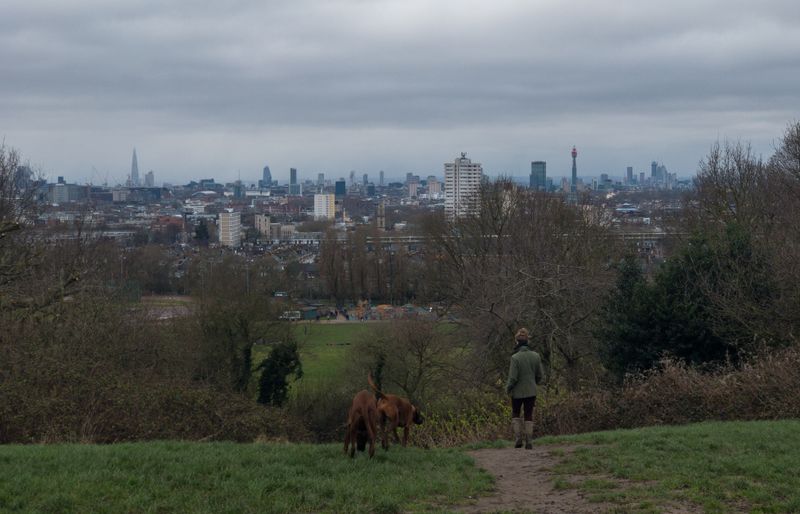
A large area of woodland, meadow and open grass on a hill, with long views over the city. It is hugely popular with dog walkers, so expect to meet plenty of other dogs. Check the City of London website for current dog rules in different areas.
Richmond Park, London
Famous for its wild deer, which means lead rules matter. Dogs must be kept under control and away from the deer, and there are specific rules about leads at certain times of year. Read the Royal Parks guidance before your visit.
Victoria Park, London
A big East London park with wide paths, open lawns and a lake. It is a good one for steady loops, and it is busy at weekends. Check the signs for any dog-free areas.
Heaton Park, Manchester
One of the larger city parks in the country, with open grassland, woodland and plenty of paths to choose from. A good one when you want a longer walk without leaving the city.
Sutton Park, Birmingham
A big expanse of heath, woodland and lakes that feels surprisingly wild for a place within a city. There is grazing livestock in some areas, so check the signs and keep your dog under control.
Fitting walkies into a busy day
We are not going to pretend that every walk can be an hour long. Some days it is 20 minutes between meetings, and that is fine. What matters is that you give the dog something to sniff and some freedom to explore, rather than treating it as a chore to get through.
Choose a loop you can finish
Pick one that fits the time you have, so you are not watching the clock and rushing the dog.
Let the nose lead
A slow sniffing walk is more tiring than a brisk march. Give them time at the interesting bits.
Use the same time and route
Dogs love routine, and so do other owners. You may find the same faces turning up.
Have a wet-weather backup
A towel in the car, a coat on the peg and a plan for when the park is a puddle.
Save the long one for the weekend
A quick loop in the week and a bigger adventure on Saturday balances things out.
- A short loop
- About 20 to 30 minutes. Good for weekday mornings and evenings.
- A proper loop
- About 45 minutes to an hour. Good for lunchbreaks and quiet days.
- Best times for nervous dogs
- Early morning, midweek and wet days, when fewer people are about.
- Where to check rules
- Gate notices, plus the council or park website for any PSPO.
Parks are busy places
City parks have joggers, cyclists, families, picnics and other dogs, all in the same space. A few habits make life easier for everybody.
Call your dog back when you see a child, a pushchair or someone who looks nervous. Put your dog on a lead if the park is busy, or if your dog is not yet reliable off it. Pick up after them, every time, and bin the bag. Not all dogs enjoy meeting others on a path, so ask before letting yours say hello.
If your dog is easily overwhelmed, try quieter times such as early morning or midweek, and read our guide to lead reactivity and needs-space walks.
Turning a loop into a pack
The nice thing about a regular loop is that other people are doing it too. On Packmates, you can post a walk with your usual park and time, and say what kind of walk it is. Over a few weeks, you might find yourself with a small group of regulars.
If you are new to an area or visiting a city, search the town on our walks page and see what is on. Or post a walk of your own, tick Flexible on time, and see who replies. Once the organiser approves your request, you agree the time and a public meeting point, such as a park gate, privately in chat.
Quick park loop checklist
- A lead that is comfortable to hold, and a reliable collar or harness.
- Poo bags in your coat pocket, so you never forget.
- A pocketful of treats for recall practice.
- A bottle of water and a small bowl.
- A quick look at the park gates for any rule changes.
- A towel in the boot for muddy days.
A short walk, done well and often, is one of the best things you can do for a dog. And if it turns into a few friendships along the way, so much the better.